
Go beyond individual keywords
Group your review phrases, search terms, LLM queries, and Geo Grid tracking into themed concepts. See how customers actually find you — and build content to match.
The problem
You're tracking dozens of keywords across different tools. Google search rankings in one tab. Local pack visibility in another. LLM mentions somewhere else. Review keywords buried in a report. None of it connects. You have data, but no story.
The solution
Keyword Concepts bundles related terms into themes that match how customers actually think. Instead of tracking "emergency plumber" and "24/7 plumbing" and "plumber near me now" separately, you track the concept of "emergency plumbing" across every channel — one concept pulling Google, Maps, and AI mentions into a single view.
How it works
Create a keyword concept
Define a theme — like 'emergency plumbing' or 'wedding photography.' Group related review phrases, search keywords, LLM queries, and Geo Grid terms under one concept.
Track performance across channels
See how your concept performs in Google search, Google Maps local results, and AI assistant mentions. One unified view instead of juggling separate reports.
Generate optimized content
Use your concept data to auto-generate landing pages with relevant copy, FAQs, SEO metadata, and schema markup. Content that's informed by real search behavior.
Refine and grow
Track progress over time. See which concepts are gaining traction, which need more reviews, and where to focus your efforts next.
Your concepts at a glance
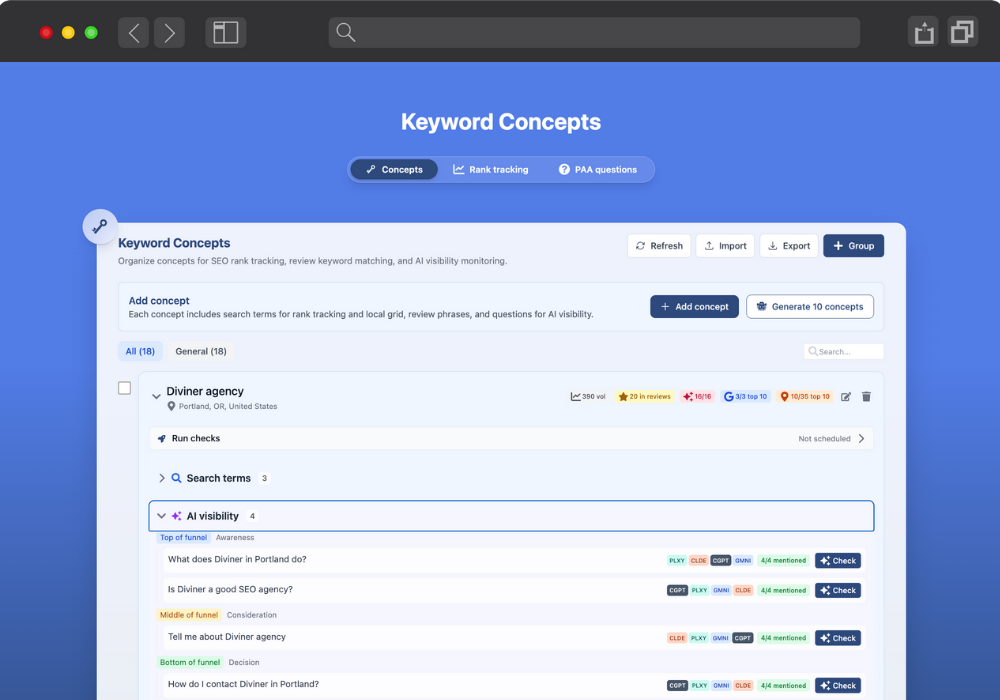
Think in concepts, not keywords
Your customers don't think in keywords. They think in needs. Now your tracking does too.
Group by intent, not keywords
Combine review phrases, Google search terms, LLM visibility queries, and Geo Grid tracking into themed concepts. See the big picture of how customers find you.
Auto-generate pages
Turn your keyword concepts into landing pages complete with copy, FAQs, SEO metadata, and schema markup. Go from insight to content in minutes.
Cross-channel visibility
Track how each concept performs across Google search, Google Maps, and AI assistants. One concept, multiple visibility channels.
Measure what matters
Instead of drowning in individual keyword rankings, see how entire themes perform. Are customers finding you for 'emergency plumber'? Now you'll know.
Frequently asked questions
- A regular keyword is a single search term. A concept is a group of related terms that represent customer intent. For example, 'emergency plumber,' 'plumber near me open now,' '24 hour plumbing service,' and related review phrases all belong to one concept: emergency plumbing. Tracking the concept gives you a complete picture instead of fragmented data.
- It creates SEO-optimized landing pages with relevant copy based on your concept, a FAQ section drawn from common queries, proper SEO metadata (title tags, meta descriptions), and structured schema markup. You review and edit everything before publishing — it's a starting point, not a finished product.
- Yes. Keyword Concepts pulls data from your Google search rank tracking, Geo Grid local visibility scans, LLM visibility tracking, and review keyword analysis. It's the connective tissue between all your tracking features.
- The tracking aspects of Keyword Concepts use credits — Geo Grid scans, rank tracking checks, and LLM visibility queries each consume credits as they normally would. Creating concepts and generating page content doesn't cost credits.
How is a keyword concept different from a regular keyword?
What kind of pages does the auto-generate feature create?
Does this integrate with the other tracking features?
Does this use credits?
See the full picture of your visibility
Stop juggling keywords. Start tracking concepts. Your first concept is a few clicks away.